
Forms of Montcalm County Deeds
A recorded deed names the parties and describes the land interest being conveyed. The Montcalm County Register of Deeds keeps deeds alongside mortgages, assignments, discharges, liens, easements, plats, releases, and other accepted instruments. The type of deed matters. Each form carries different promises or different authority to convey. Read the document itself. The operative language lives there rather than in the index label.
| Deed Type | What It Does | Common Use |
|---|---|---|
| Warranty deed | Conveys the stated interest with covenants written in the instrument. | Many arm's-length sales. |
| Quitclaim deed | Conveys whatever interest the grantor has without the same covenants. | Family transfers and title cleanup. |
| Trustee deed | Transfers property through authority held by a trustee. | Trust administration. |
| Personal representative deed | Conveys estate land through stated probate authority. | Estate administration. |
| Tax deed | Records a transfer tied to the tax-foreclosure process. | Tax-foreclosed land. |
A deed transfers whatever interest it describes. Mortgages and liens work differently. They burden an interest rather than pass it. After you find an encumbrance, search assignments, discharges, satisfactions, and releases. The first filing alone never shows whether the burden stayed active.
Montcalm Deed Index Fields
The official Register of Deeds search form shows how staff-assisted deed records research gets keyed. It makes the fields plain. Give more than a name whenever you can. A recording date range, document type, address, or legal description helps. Each one separates people and entities with similar names. A liber and page reference is the strongest of all. The form itself states that a known-reference search carries no search charge. That makes it the thriftiest route into Montcalm County property records.
| Request Field | What to Enter | Why It Helps |
|---|---|---|
| Liber and page | The recorded book and page reference | Targets a known image directly. |
| Grantor and grantee | Names plus known capacity | Finds the giving and receiving sides. |
| Legal description or address | Lot, subdivision, section, tract, or situs | Bridges name changes and close matches. |
| Document type | Deed, mortgage, release, lien, or other instrument | Narrows a busy name result. |
| Date range | Approximate recording span | Controls both scope and name-search cost. |
The form also collects contact and delivery information, added names, and other details that help staff. For a name request, be ready to supply grantor or grantee names. An approximate start or recording date rounds out the request.
The Montcalm 1988 Index Line
Montcalm's computer grantor-grantee index covers 1988 to the present. Computer images reach back further, to 1950. But only when liber and page are already known. Those are two different coverage rules. A 1970 deed image can exist. No computer name query will ever surface it. Handwritten grantor and grantee books, deed books, and tract tools carry the earlier period.
Two cutoffs matter. Use the computer name index for 1988 forward. For 1950 through 1987, first find the liber and page in an older index, then request the image.
The county search form says records extend to 1856, while the office description mentions handwritten books from 1850. Treat that gap as a difference between record series rather than an error. Give the office the record type and the date you need instead of forcing one start year onto every Montcalm County deed record.
Tapestry's Changing Montcalm Route
The county directs public deed searches to Fidlar's Tapestry service. The current platform notice moves users toward Tapestry Eon at LandRecords.com. Access or image charges may apply. Anyone holding old bookmarks or printed instructions should take note. Start from the county office page. That way a portal migration does not look like missing deed records. The official Tapestry notice shows the service transition and the current route.

Read the notice as access guidance only. It does not change which county office keeps the recorded instruments.
Follow Montcalm Grantors and Grantees
A grantor gives the stated interest; a grantee receives it. Begin with the latest likely owner and the legal description from the assessor record. Find a recent deed where that party appears as grantee. Then read back through the grantor and the prior instrument reference. A surname may change. Title may pass through an estate, trust, or company, and the legal description becomes the control.
- Find the newest deed where the present party is listed as grantee. Record its date, type, document number or liber/page, and land description.
- Read the grantor from that deed. Search that prior party as grantee in an older span.
- Compare legal descriptions and prior references at each link. Track changes caused by splits, plats, trusts, or estates.
- At the computer cutoff, move to handwritten name books, the tract index, microfilm, or archival copies.
- Grantor
- The party conveying the stated interest.
- Grantee
- The party receiving the stated interest.
- Chain of title
- The linked series of recorded transfers affecting the same land.
- Liber and page
- The book-and-page reference used to retrieve a recorded document.
Historic Montcalm Deed Books
Older Montcalm County deed records call for a second research path. FamilySearch catalogs 46 microfilm reels of deed records. They cover 1838 through 1934. An index spans 1838 through 1903, all filmed from courthouse originals. The Archives of Michigan guide identifies land and tax-related county series. The Library of Michigan county guide points to plats, newspapers, and local history that help decode old place names.
A historic chain may therefore run from the computer index to a handwritten name book. It can then lead onward to a FamilySearch film or an archives record group. Preserve the film, digital image group, or record-group identifier with every citation. A newspaper or plat label can suggest a search term, but it cannot replace the deed or establish a modern boundary. That entry cannot establish a modern boundary either.
One archive entry is an 1854 deed for land purchased from Native Americans. That is a distinct historic record. It is not a shorthand claim about the ownership history of every later parcel.
Capacity in Montcalm Conveyances
Trust, estate, and company transfers often break a simple surname chain. Read the capacity after each name. A trustee, personal representative, bank, LLC, or survivor may sign under authority described in the instrument. A linked probate record can also supply that authority. Search the exact entity name plus common punctuation variants. But never turn a deed party into an unnamed beneficial owner.
When a personal representative conveys estate land, probate and deed files answer separate questions. The probate file shows appointment and authority. The recorded deed shows the conveyance itself. A death certificate proves a death, not the later transfer of real property. So keep case, probate, and deed references distinct throughout your property search in Montcalm County deed records.
Liens Beside Montcalm Deeds
A deed chain is only half the picture. Liens and releases tell the rest of the story. Once you have the names and legal description, search Montcalm County records for mortgages, assignments, discharges, construction liens, tax instruments. Look also for easements, restrictions, and notices. An assignment shifts a mortgage to a new holder. The owner of record stays the same. That is why a parcel number alone can miss the paperwork.
Do not treat a single empty name search as proof of anything. Instruments get indexed under different roles, variant entity names, or older parcel descriptions. Gaps are common. Court files can supply quiet-title, partition, or foreclosure context. Still, confirm any case outcome against the filed documents and the deed index itself.
Order Montcalm Deed Copies
Getting Montcalm County deed records is straightforward. Copies come three ways: online, at the counter, or by asking staff. The office sits at 211 W Main Street in Stanton. Mail goes to PO Box 368, Stanton, MI 48888. Call the Register of Deeds at 989-831-7337 or email ROD@montcalmcountymi.gov. The official request form can be mailed or faxed to 989-831-7320. Before visiting, confirm public-terminal access, hours, and the recording cutoff.
Fees are modest but add up. The published form lists copies at $1 per page. A fax charge runs $5. A name search costs $5 plus $0.50 per year. The county schedule adds a $5 certified-document charge along with several online and tract-search fees. Portal prices shift, so verify the current total first. When a court, probate, or closing needs an authenticated copy, ask for certification up front.
The Register of Deeds office page gathers the county's official search links, recording guidance, and contact route. It also offers a fraud-alert option.
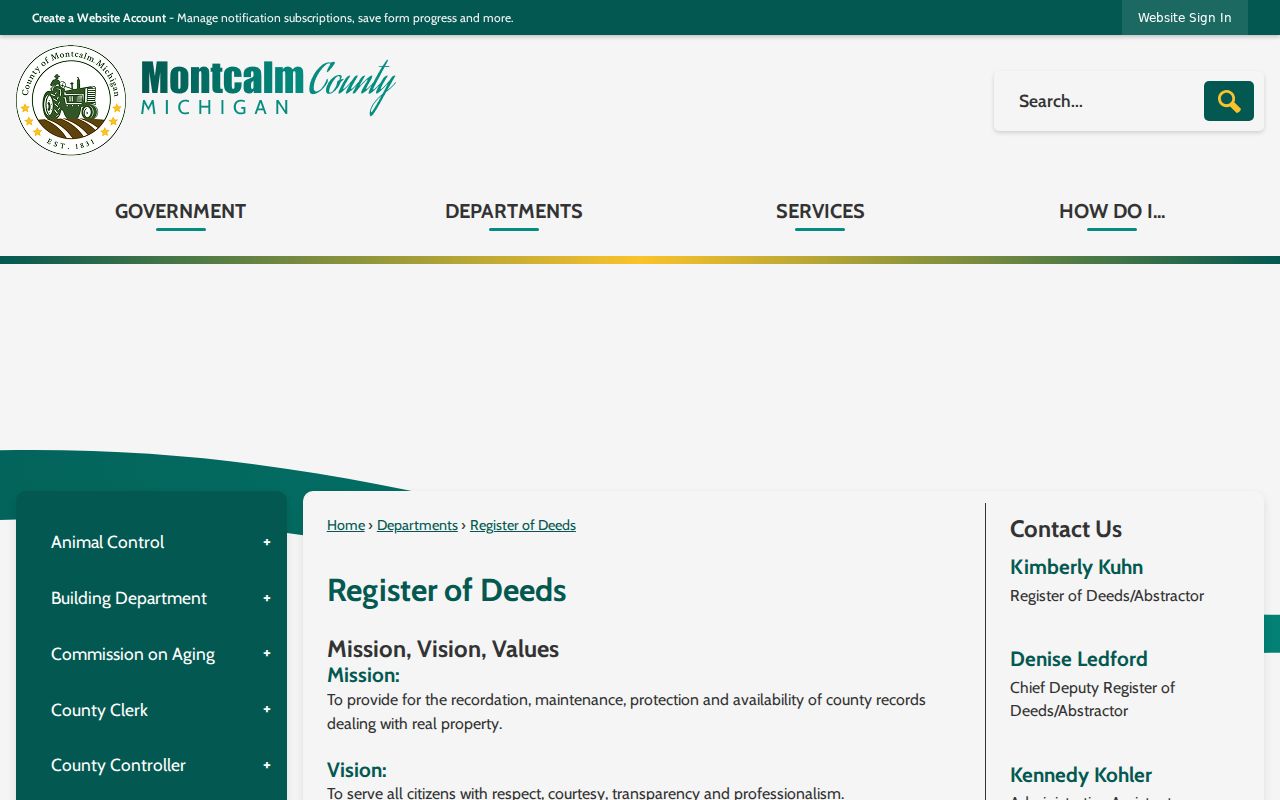
Start with the office page whenever an old bookmark or a third-party instruction disagrees with the county's current route. It beats guessing.
Recorded, not guaranteed. The Montcalm deed index reports filed instruments. It is not a title opinion, and it cannot rule out an unrecorded interest or indexing error.
A mailed request needs a return address. It also needs whatever payment and self-addressed-envelope steps the current form specifies. For fax delivery, include your fax number and budget for the listed charge. Email works well for confirming the right series and procedure. Just avoid sending sensitive personal data unless the office directs you to a secure route.
Write down everything that identifies the instrument. That means the document number or liber and page. It also means the document type, recording date and time, grantors, grantees, legal description, page count, and any prior-instrument reference. If consideration or transfer-tax figures appear, copy the label and value exactly. Do not read them as market value. This inventory lets you cite a plain or certified copy cleanly. It also lets a later searcher retrace the same chain.