
Inside Montcalm Property Tax Records
A Montcalm County tax account is really a web of connected facts. Local assessors build the rolls. County Equalization keeps standards consistent across 23 taxing jurisdictions. City, township, and village treasurers then mail the summer and winter bills. Once March 1 passes, delinquent real-property taxes belong to the County Treasurer. That handoff explains a common puzzle. One screen shows the current assessment. A different office controls an overdue balance on the same parcel.
Start any first pass by matching the parcel number and tax year. Splits, combinations, and local-unit changes can leave a stale account lingering in search results. The owner or taxpayer line helps confirm you have the right account. Still, only the recorded deed establishes who holds title.
| Record field | What it answers | Official source |
|---|---|---|
| Assessed value and SEV | The value placed on the roll under Michigan assessment rules | Local assessor and BS&A |
| Taxable value | The value to which authorized millage is applied | Assessment and tax record |
| PRE or exemption flags | Whether a recorded tax status affects the account | Local assessor |
| Summer and winter bill | Charges, authorities, payments, and current balance | City, township, or village treasurer |
| Delinquent balance | Interest, fees, forfeiture, and county-stage status | Montcalm County Treasurer |
A sale price is not a tax value. Michigan law defines true cash value as the usual selling price. Assessed and state equalized value generally sit at 50 percent of that figure. Taxable value can diverge from both. Its annual growth stays capped because a transfer or similar event triggers uncapping.
Two Montcalm Tax Routes
Current bills stay local. Montcalm County says city, township, and village treasurers generally mail summer bills July 1. Winter bills generally go out December 1. Confirm due dates with that local office. After March 1, delinquent real-property taxes move to the Montcalm County Treasurer. Personal property and buildings on leased land remain local responsibilities regardless.
The handoff trips up many searchers. The county's property-tax information page points to BS&A for current records. It also spells out the delinquent path. For county online payment, the Treasurer asks users to drop the leading 59 from the parcel number. Keep the full number for notes and every other search.
Note: A current local bill and a county delinquent account can cover different tax years for the same parcel.
Search Montcalm Tax Bills
The official Montcalm County BS&A landing page splits its tools into Assessing Search, Current Tax Search, and Delinquent Tax Search. The focus you pick determines the department. Search by then accepts an address, name, or parcel number where the service supports it. For tying a roll entry to a bill, nothing beats the parcel number.
- Start with the street address in BS&A and copy the complete parcel number from the matching result.
- Open the assessment detail. Confirm the situs address, local unit, tax year, assessed value, taxable value, and any PRE or exemption flag.
- Open Current Tax Search for the same parcel and year. Record summer and winter charges, payment dates, and receipt details.
- If the year is delinquent, move to the County Treasurer route and follow its parcel-entry rule. Check the county auction page if foreclosure status is at issue.
The current-tax search screen shows the municipality and parcel route.
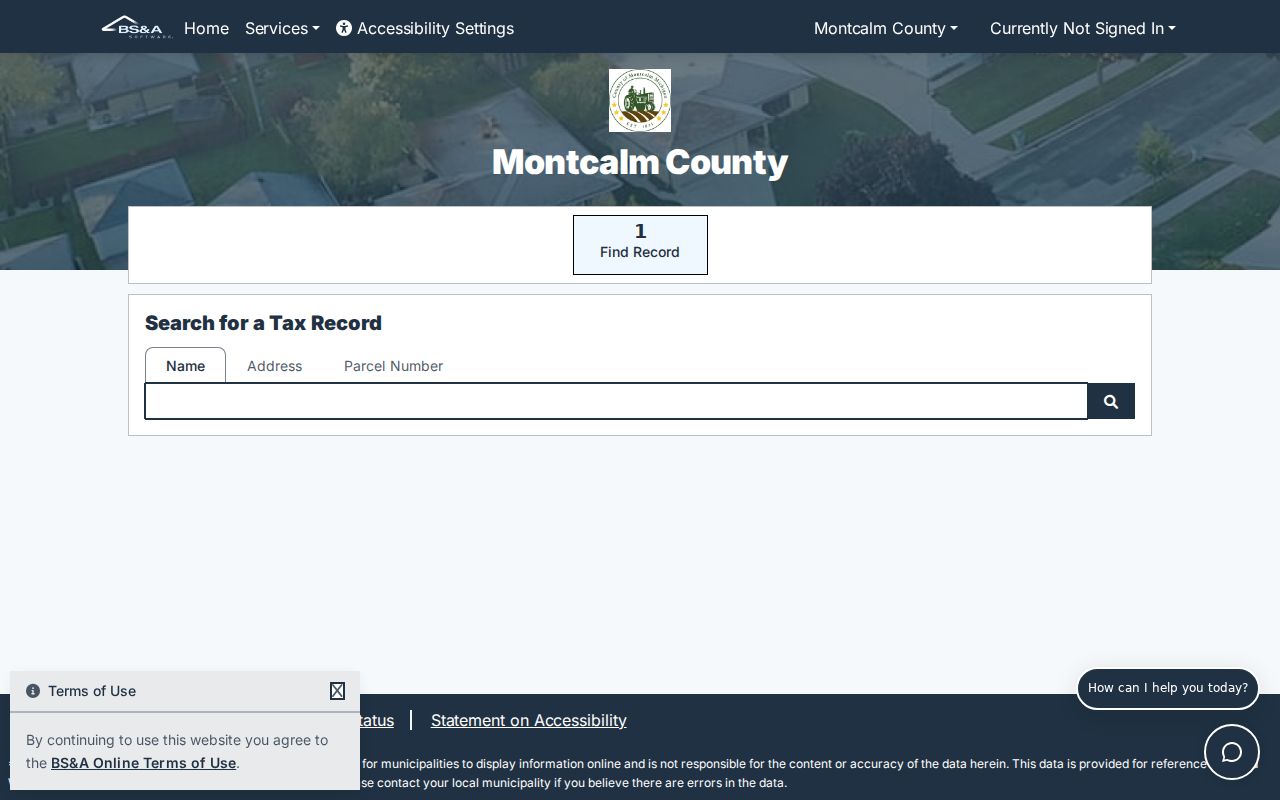
The search screen is only a doorway. Open the account itself and record its year, local unit, and status before trusting any result label.
Read Montcalm Tax Values
Montcalm County property records display several value labels that look alike. Read each as a separate step in the calculation. A low taxable value does not mean the parcel would sell for that figure. Likewise, a consideration amount on a recent deed does not automatically become the next assessment.
- Assessed value
- The assessor's value, generally set at 50 percent of true cash value under Michigan law.
- State equalized value
- The assessed value after equalization, often shortened to SEV.
- Taxable value
- The capped value used with authorized millage to calculate tax.
- Millage
- A tax rate expressed in mills and applied to taxable value.
- Principal Residence Exemption
- A status, often called PRE, that can affect school operating taxes for a qualifying principal residence.
- Tax lien
- The legal claim arising from unpaid property tax, subject to Michigan's forfeiture and foreclosure process.
MCL 211.27 and Michigan's Chapter 211 provisions supply the value-law source. For meaning beyond the bill, the property value explanation sorts the three types apart. It keeps assessed, state equalized, and taxable value distinct.
Montcalm Transfer Filing Window
Michigan's Property Transfer Affidavit, Form 2766 or L-4260, links each new conveyance to the assessment system. The buyer must file it with the local assessor within 45 days. It asks for the property identification number, purchase price, seller and buyer, transfer date, property type, exemptions, and signatures. Filing on time helps explain any taxable-value shift after a sale.
No fixed roll-refresh schedule is published for Montcalm County. A deed can sit recorded while the assessor account still shows the prior owner. Compare the deed date, affidavit filing, tax year, and account update. None of these systems changes on closing day by default.
Transfer timing. The 45-day filing duty is not a promise that BS&A will display a new owner within 45 days.
When Montcalm Taxable Value Changes
Michigan keeps assessed value and taxable value separate. A parcel's taxable value generally grows under an annual cap. A transfer of ownership can uncap it in the following tax year. The assessor then applies the state's rules to that parcel. The recorded sale amount counts as evidence. State law still forbids setting assessed value from sale price alone.
Check for a transfer exception before concluding anything. Trust, estate, family, and entity transactions can carry facts that change the outcome. The assessment notice and the assessor hold the applied classification. Deeds and affidavits show transfer facts, but neither substitutes for the roll determination.
Note: An escrow estimate may lag the next tax-year uncapping. So compare closing papers with the later assessment notice.
Contest a Montcalm Assessment
A Montcalm County owner who questions an assessment starts with the notice itself. It names the local assessor, the Board of Review date, and the protest method. The local assessing unit prepares the roll. The county Equalization office only coordinates standards across units. Michigan Treasury publishes the petition and the Board of Review pathway. Some claims must go through protest before any appeal to the Michigan Tax Tribunal.
Evidence should be parcel-specific. Bring the assessment notice, record-card errors, dated photographs, and measurements. Sales that truly compare help. A survey settles a land-size dispute. Documents showing an exemption or transfer matter too. File within the deadline printed for that cycle. Skip the generic annual date when the current notice gives the controlling local schedule.
Protect the appeal window. Confirm the current local Board of Review date and filing rules through Michigan Treasury and the assessor named on the notice.
Montcalm Delinquency and Foreclosure
Unpaid real-property tax in Michigan moves into a statutory county process after the local stage. Interest and fees accrue. The account can be forfeited and noticed. It can finally be foreclosed and auctioned if redemption comes too late. Montcalm's PA 123 information and property auction page carry county notices, auction routes, unsold-parcel details, and surplus-proceeds guidance.
A sale list never replaces the live account. Verify the parcel number and owner mailing information. Also verify case or notice dates, redemption status, and amounts with the Treasurer. The county says plainly that it does not contact former foreclosed owners to solicit surplus-proceeds services. Check urgent payment demands from an unverified caller against the published county number.
Get Montcalm Tax Records Offline
Online access is only one channel. A local treasurer can answer questions about a current tax bill. County offices at 211 W Main Street in Stanton handle the assessment, Equalization, and delinquent-tax routes. Typical public hours are 8 a.m. to 4 p.m. Call before visiting. The current fee schedule lists a $5 tax certification and a $6.35 per-parcel BS&A lookup. Confirm fees before ordering.
For a narrow record outside BS&A, submit a written request. Use the Michigan Freedom of Information Act route. Identify the parcel, street address, tax or assessment series, date range, and preferred inspection or copy format. Montcalm accepts county FOIA contact by email and fax. It asks requesters to wait for a fee notice before paying. Originals stay with the county.
Certification matters when a formal balance or tax status must be proved. A screen capture helps as working evidence. It is not the county's certified tax statement.