
Compare Montcalm County Property Values
A Montcalm County parcel can carry several values at once. Assessed value and state equalized value grow out of Michigan's assessment system. Taxable value is a separate animal, shaped by statutory limits and by transfers. A recorded price marks one transaction. Market value speaks to what the parcel would usually sell for under the relevant valuation date and conditions.
| Value | What It Is | Where |
|---|---|---|
| Assessed value / SEV | Tax assessment at Michigan's statutory relationship to true cash value | Local roll and BS&A detail |
| Taxable value | The figure used with millage to compute tax, subject to caps and uncapping rules | Assessment and tax record |
| Market or true cash value | Usual selling-price concept under Michigan law | Assessment analysis, not a sale promise |
| Last sale price | Consideration tied to a past transfer, when reported | Deed, transfer affidavit, or sale-history field |
Michigan law generally pegs assessed value at 50 percent of true cash value. That percentage is an assessment level. It is not a discount. Doubling the assessed figure will not predict a sale price, because sale terms, date, condition, and statutory valuation factors all push the outcome around.
Read Montcalm BS&A Value Fields
The Montcalm County BS&A collection opens onto assessing, tax, permit, utility, and detailed searches. An assessment detail can list land, building, total assessed, state equalized, and taxable values. The same card may carry the tax year, parcel number, class, legal description, sale history, and exemption flags. Field availability depends on the local assessing unit.
Read each value with its year and parcel identity. Montcalm Equalization supports 23 taxing jurisdictions. Local assessors prepare and maintain the rolls. The county publishes no single countywide refresh schedule covering every parcel card.
The official assessing-search page displays that entry point.
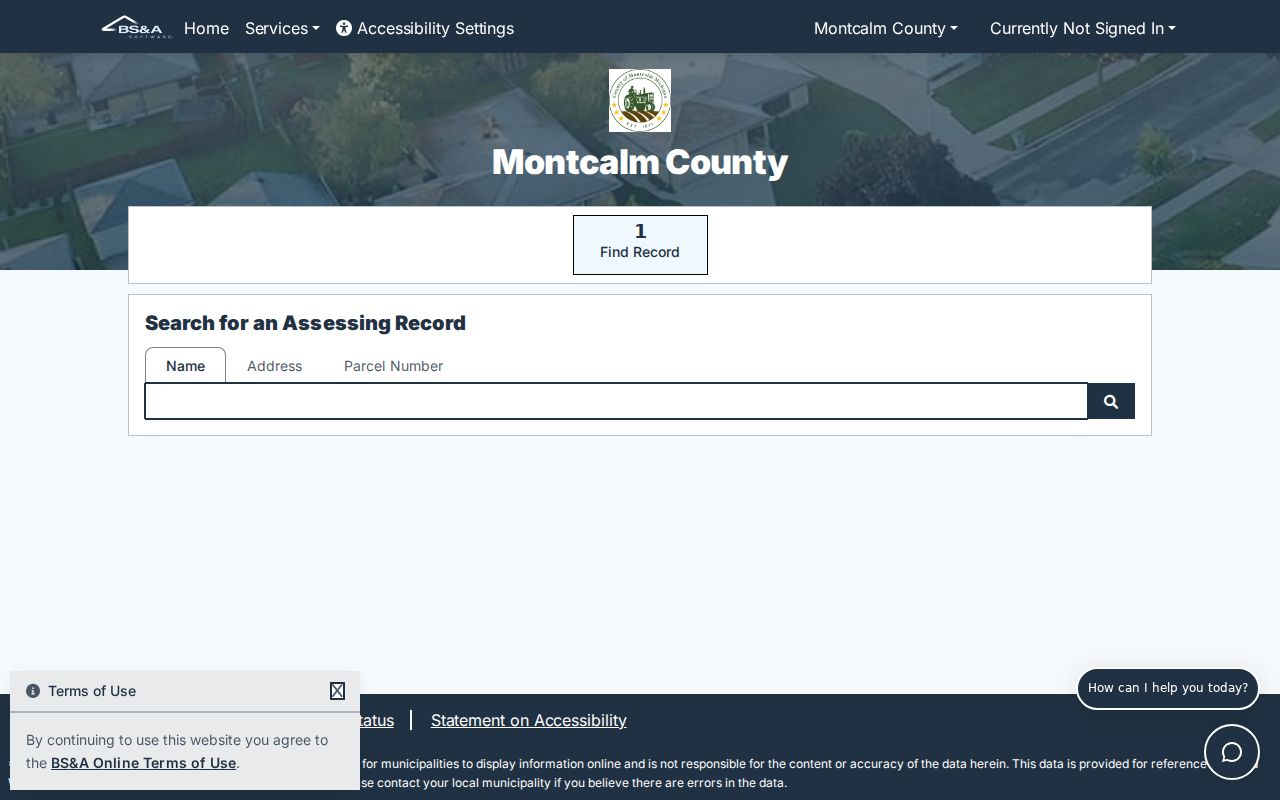
The search screen is a route, not an appraisal. Open the parcel detail and keep the exact labels shown for that parcel.
Estimate Montcalm Assessed Value
Start with the address. Keep the parcel number as your cross-system key. BS&A documents Address, Name, and Parcel Number search modes, and Detailed Search can narrow an application-specific query when a simple lookup is too broad.
- Search the situs address and choose the correct municipality and parcel.
- Record the full APN, tax year, class, assessed or SEV figure, and taxable value.
- Capture land and building components if the live record displays them.
- Check sale history, then compare any price with the recorded deed and transfer date.
- Date the search and note missing fields rather than inferring them.
- Assessed value
- The local assessor's valuation before the separate taxable-value rules are applied.
- Market or true cash value
- Michigan's usual selling-price concept for assessment purposes.
- Assessment ratio
- The relationship between assessed value and true cash value, generally 50 percent in Michigan.
- Sale consideration
- The price or value stated for a transfer, when public and applicable.
- Reassessment
- A new valuation for a later assessment year, not a private appraisal.
Separate Montcalm Taxable Value
Taxable value is not another name for assessed value. Michigan's cap can limit its annual growth until a transfer uncaps it under state law. A principal residence exemption eases the tax bill. It never redefines the assessed figure.
A transfer starts two clocks. The deed carries a recording date, and the buyer must file a Property Transfer Affidavit with the local assessor within 45 days. Montcalm publishes no standard closing-to-roll update interval, so record the BS&A tax year and your search date when weighing a recent sale.
Note: A stale parcel card can reflect processing time; it does not erase a later recorded conveyance.
Find Montcalm Recorded Sale Price
A sale-history row is context, not the deed itself. The recorded instrument may show consideration or transfer-tax details. The Property Transfer Affidavit carries a purchase-price field. Not every sale makes a fair comparison. Nominal, exempt, related-party, and fiduciary transfers all distort the picture.
Match the transfer through the Register of Deeds. Search by grantee, grantor, legal description, and liber/page or instrument number. The office takes online, terminal, in-person, mail, fax, phone, and email requests. When you need proof, request the recorded document rather than trusting a summary row.
Compare Montcalm Nearby Sales
Nearby parcels are only candidates. Start with the same class, similar land and building traits, and a close valuation date. Then ask whether each sale was arm's length. A parcel across a road or water can sit near the subject yet offer very different access or site features.
The county GIS maps parcel, subdivision and condo, road, lake and river, and trail themes. Those layers frame a comparison. They supply no certified boundary, appraisal, or sale condition. Keep the recorded sale date and deed type with each candidate.
Montcalm Map Vintage Can Mislead
Stanton's published zoning map rests on an August 2013 parcel base. It uses June 2016 aerial photography. That vintage is the warning. An official map can still preserve older geometry or imagery. Weigh any dated map against the current parcel record before drawing a value conclusion.
Planning labels, zoning districts, and future-land-use ideas add context, not appraisal adjustments. A sound value analysis needs a defined date. It also needs a lawful valuation method. And it needs property facts from the relevant record.
Request Missing Montcalm Value Records
Online access is not the only channel. Equalization takes questions at Equaldept@montcalmcountymi.gov and keeps offices at 211 W Main Street in Stanton. Local assessors maintain the rolls and hear the first review questions. Call ahead for current hours and record availability.
Missing history has a paper route. File a narrow Montcalm County FOIA request by APN, record series, and year. The county asks requesters to wait for a fee notice and releases no originals. For older context, Archives of Michigan assessment rolls from 1850 through 1930 can add historical value depth.
Limit Montcalm Property Value Claims
An assessed value feeds the property-tax system in Montcalm County. That is its whole job. It is not a private appraisal, a title opinion, or a boundary survey. It makes no promise about what a buyer might pay. A sale price recorded in the deed records describes a single transaction. Abnormal market conditions can hide behind that one number. Treat it carefully when comparing values.
Value is not price. A Montcalm County assessed value is for taxation. It is not the property's guaranteed sale price or a licensed appraisal.
Questions about tax bills, exemptions, or appeals belong in the dedicated Montcalm County property tax records explanation. Keep any value comparison focused on where each figure came from and what it actually records.